
The first time you send a bet on the blockchain, it feels oddly quiet.
There is no cashier window. No sportsbook clerk. No spinning wheel on a server you cannot inspect. You tap a button in a betting dApp, approve a transaction in MetaMask, and then stare at a wallet notification while the network does its thing. If you are used to traditional online betting, the silence is almost unsettling. Money moves, but not in the usual way. There is no bank card processor in the middle, no visible house account ledger, no support agent manually reviewing your withdrawal. Instead, a public network takes over, and every step leaves a trail.
That difference is the whole story.
A blockchain wager is not just a digital version of a normal bet. The plumbing is different, the trust model is different, and the risks are different. Once you understand what actually happens between the moment you click “place bet” and the moment a payout lands back in your wallet, a lot of the hype around blockchain betting starts to sort itself into useful categories. Some parts are genuinely better. Some are just packaged to look futuristic. And some can hurt you fast if you do not know where the weak points are.
I have watched people treat crypto bets like magic internet coupons, and I have watched others overcomplicate the whole thing as if they were personally validating blocks in a data center. In practice, the process sits somewhere in between. It is technical, but not mystical. It is financial, but not exactly like using a bank. And once you have done it a few times, the flow becomes pretty intuitive.
The moment you commit the bet
At the surface level, sending a bet on the blockchain looks simple. You connect a crypto wallet, choose a market, enter an amount, and confirm. Underneath that easy interface, though, you are not “sending money to a betting site” in the old sense. Most of the time, you are signing a blockchain transaction that tells a smart contract to perform a specific action.
That action depends on the platform. On a decentralized betting platform like Augur or Polymarket, you might be buying shares in an outcome market rather than placing a bet in the bookmaking sense. On a casino style dApp, you might be sending funds to a smart contract that locks in your wager, records the rules, and later pays out automatically if the result goes your way. On a peer-to-peer betting setup, the contract may hold funds from multiple participants in escrow until conditions are met.
The important point is that the bet usually becomes an onchain instruction. The Ethereum blockchain, the Solana network, or a Polygon layer-2 does not care that you think of it as a bet. It sees data: wallet address, token amount, contract call, gas payment, and a request for state to change.
That is why the first real step in the blockchain wager process is not “depositing into your betting account.” It is authorizing a transaction from your wallet.
If your wallet holds USDC on Polygon, for example, and you place a $50 sports prediction position, you may first sign an approval transaction that allows the smart contract to access that USDC. Then you sign a second transaction to actually place the position. New users are often surprised by this two-step flow. They think the app is broken or charging twice. Usually it is just following token permission rules.
This is also where costs begin. On Ethereum mainnet, gas fees can make small bets irrational during busy periods. A $15 or $20 wager can get eaten alive if network activity spikes. On Solana, fees tend to be much lower, which is why many users who want fast, cheap crypto gambling transactions prefer it. Polygon sits in a middle ground that works well for casual users who want Ethereum compatibility without Ethereum pain.
Your wallet is doing more than holding coins
People talk about crypto wallets as if they were just digital pockets. They are closer to a signature device with a balance attached.
When you use MetaMask or another wallet on a decentralized betting platform, the wallet proves you control the funds and authorizes contract interactions. It also becomes your identity layer. The platform may not ask for a username in the traditional sense because your wallet address already serves as one.
That wallet address becomes central to everything. It is where your tokens sit before the bet. It is the source of the transaction. It is the destination for settlement and payouts. And it is the record that block explorers use to show what happened.
This has two practical consequences that people only learn after a mistake.
First, if you send from the wrong network, nothing good happens. Sending USDC on Ethereum to an app that expects USDC on Polygon is a classic beginner error. The token symbol may look identical, but the network context matters. A lot. Second, if you connect your wallet to a sketchy dApp and approve broad spending permissions, you can expose far more than your intended wager. In normal banking, accidental over-authorization is rare. In decentralized finance bets and gambling dApps, careless token approvals are one of the most common self-inflicted wounds.
I have seen people obsess over whether a platform is “provably fair” and then grant unlimited token access to a random contract they found through social media. That is like checking a roulette wheel for bias while leaving your apartment door open.
What the smart contract actually does
Smart contracts are where blockchain betting becomes more than a payment rail.
A smart contract is code deployed onchain. Once live, it follows predefined rules. If written well, it removes a lot of discretionary power from the operator. Instead of trusting a site to remember your bet correctly, hold the funds honestly, and pay out when convenient, you trust the contract logic and the network that executes it.
That sounds cleaner than it always is, but the basic value is real.
In a traditional sportsbook, the platform maintains a private database entry saying you placed a wager at a certain line and stake. In a blockchain system, the contract may store those terms in public state or emit event logs that anyone can inspect later. That creates an immutable ledger of what happened. Once the bet is recorded and enough block confirmation has occurred, it is much harder for an operator to quietly rewrite history.
This is where terms like smart contract execution and transaction verification matter. The contract is not “thinking” about your bet. It is just applying logic. Did your wallet send the right amount? Is the market open? Is the selected outcome valid? Has the deadline passed? If those checks pass, the contract accepts the wager and updates its state.
If the contract is handling a binary event market, it might mint position tokens. If it is running a casino game, it might register your stake and trigger a randomness request. If it is acting as escrow between bettors, it might lock all funds until an oracle supplies the outcome.
No customer support team needs to wake up for that. The network executes the code.
That said, smart contracts are only as good as their design. A bug in contract logic can break payout conditions, freeze funds, or create arbitrage that drains pools. This is why audited code matters. It is also why decentralized gambling is not automatically safer than centralized betting. It simply moves the trust problem from one place to another.
The trip from your phone to the chain
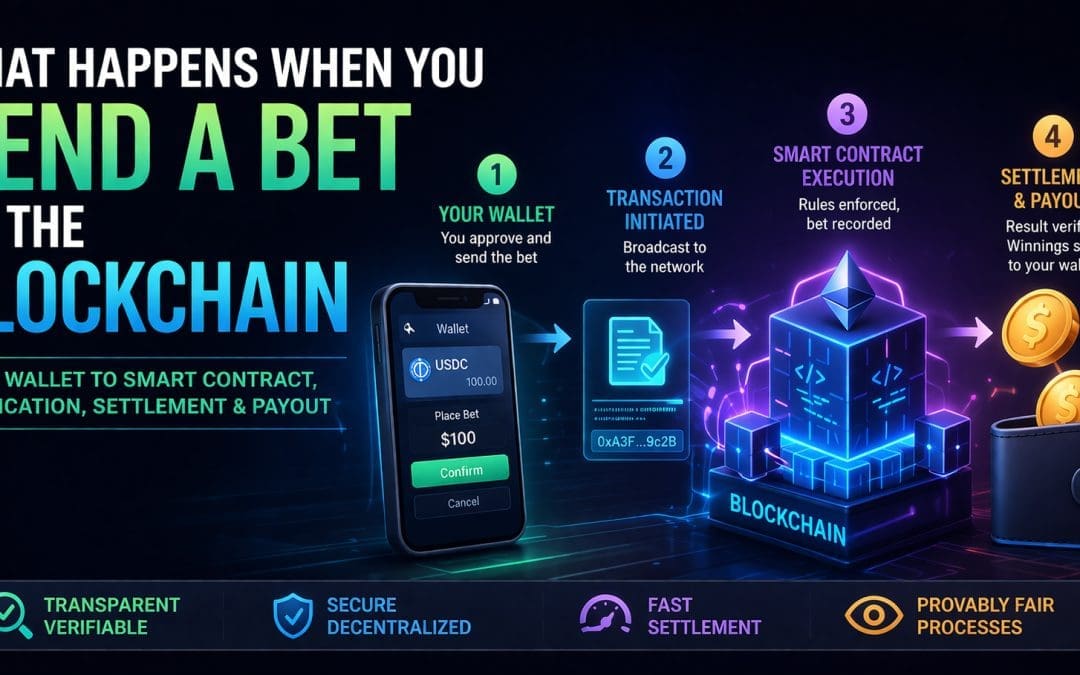
The cleanest way to understand the step-by-step bet journey is to think of it as a relay race between four systems: your wallet, the dApp interface, the blockchain network, and the contract.
Here is the short version:
- You choose the wager inside the app and sign a transaction request with your wallet.
- The transaction is broadcast to the network and waits in a queue or mempool.
- Validators include it in a block, and the contract state updates if execution succeeds.
- The platform or the contract later settles the result and returns winnings to your wallet.
That sounds tidy, but each stage has its own friction.
The dApp interface can mislead you if prices move while you are confirming. Your wallet can show a gas estimate that changes seconds later. The network can delay confirmation if traffic spikes. And the contract can revert the transaction if the market closed a moment earlier or liquidity changed.
This is why experienced users do not treat the first on-screen quote as final truth. Onchain betting has state changes happening in public, often in real time. If you are interacting with a prediction market during breaking news, odds can shift while your transaction is still pending. On slower networks or during congestion, that lag matters.
The transaction hash becomes your receipt. Once you confirm, the wallet gives you a unique identifier. With that transaction hash, you can open a block explorer and see whether the bet is pending, confirmed, or failed. That is a big change from centralized betting, where you usually have to trust the platform’s internal status page.
A failed transaction is one of those details that surprises newcomers. In many blockchain systems, failure does not always mean zero cost. On Ethereum especially, a reverted transaction can still burn gas fees because validators still processed the computation. You can lose money without ever successfully placing the bet. It is not usually a large amount on cheaper networks, but on Ethereum mainnet during heavy activity, it can be annoying enough to change behavior.
Verification and consensus are the invisible referees
Once your transaction is out on the network, your bet is no longer in the hands of the app interface. It becomes a consensus problem.
Validators on Proof-of-Stake systems like Ethereum and Polygon confirm that your transaction is valid, that the signature matches your wallet, that your balance covers the amount and fees, and that the contract call obeys the protocol rules. Solana does this with a different architecture and performance profile, but the broad idea is similar. The network agrees on state updates.
This is where people use phrases like consensus mechanism and transaction verification, sometimes a bit too casually. What matters in practice is that many independent participants enforce the rules instead of one company database admin doing it privately.
That distributed verification gives blockchain sports betting and other crypto wager systems a level of transparency that traditional betting rarely matches. You can inspect contract activity. You can verify when funds moved. You can see when settlement happened. In some systems, you can even inspect liquidity conditions and outstanding positions before you enter the market.
But transparency is not the same as simplicity. If you have ever pulled up a block explorer after placing a bet, you know the raw data is not exactly friendly. You get contract addresses, token transfer logs, internal transactions, and event emissions that look like machine language with a user interface. The information is there, but it is not built for beginners.
Still, once you learn what to look for, it is useful. You can verify whether a bet genuinely hit the chain or whether the front end merely showed you a spinner. You can check whether the contract took the exact token amount expected. You can see if a payout was sent but missed in your wallet UI because the token list failed to refresh.
That ability to self-audit is one of the underrated benefits of a bet on blockchain systems. It does not remove risk, but it gives you evidence.
Real-world outcomes need a bridge
Not every bet resolves from blockchain-native information.
If the wager is about an onchain event, settlement can sometimes be direct. But if you are betting on a football score, an election result, or whether a certain market closes above a price, the contract needs outside information. Smart contracts cannot natively read live sports feeds, news reports, or exchange data. They need oracles.
This is where Chainlink oracles and other oracle data feeds enter the picture. Oracles deliver external facts to the contract so it can settle outcomes. In sports, that might mean feeding final scores. In prediction markets, it might mean reporting the official resolution of an event. In price-linked markets, it could mean delivering a trusted reference price.
This is also the part of decentralized betting platforms that deserves the most skepticism.
The smart contract can be beautifully written, the network can be secure, and the ledger can be immutable, but if the oracle data is wrong, late, manipulable, or disputed, settlement gets messy. Many of the hardest edge cases in decentralized gambling are not about pure contract execution. They are about what happens when reality is ambiguous.
Was a match officially abandoned or merely suspended? Which data provider counts overtime for this market? What happens if a result is corrected hours later? How does the protocol handle a disputed election before certification? These are not code-only problems. They are governance problems.
Experienced users learn to read the market rules closely before assuming a contract will settle “fairly.” Fairness comes from rule clarity plus reliable data, not from the word blockchain appearing in the app description.
Settlement feels magical when it works
When settlement is smooth, it really does feel better than old-school betting.
You send the crypto bet. The market resolves. The smart contract executes the payout rules. Funds arrive back at your wallet without a cashier queue, a withdrawal review, or the usual dance of proving your own identity to retrieve your own money.
That clean settlement flow is one of the strongest arguments for blockchain bet settlement. If the platform is truly decentralized, there may be no operator with the power to delay your payout for “manual compliance review” after you win. The contract just pays.
On prediction markets, settlement can happen through token redemption. If you hold winning shares representing a resolved outcome, you redeem them for collateral. On casino style games, the contract may send winnings automatically after randomness resolves. On peer-to-peer models, locked escrow funds get released according to contract terms.
This can be fast, but fast is relative. A Solana-based game may settle in a user-visible way within seconds. An Ethereum system may require several confirmations, then later oracle finalization, then a separate redemption transaction. “Instant” is often marketing language. In real use, you should expect a range from seconds to several minutes, and sometimes longer if the market depends on real-world data confirmation.
The upside is that the delay is usually visible and explainable. You can inspect where things stand instead of emailing support into the void.
Why people like provably fair systems
The phrase provably fair gets thrown around a lot in crypto gambling, sometimes honestly, sometimes not.
At its best, provably fair gaming means the randomness or game logic can be independently checked by users rather than trusted blindly. For example, some games use cryptographic methods that let players verify that the outcome was not secretly manipulated after the fact. That is a meaningful upgrade over black box systems where the operator tells you to trust the server.
But the phrase has limits. A game can be provably fair in its randomness and still be economically bad for players. A platform can prove that the dice roll was generated honestly and still charge unattractive fees or build a payout structure that heavily favors the house. Transparent loss is still loss.
The more useful question is not “is this provably fair?” but “which part is provable, by whom, and under what assumptions?” If the answer is only that one randomness module is auditable while treasury controls remain centralized, then you are not looking at some pure trustless paradise. You are looking at a hybrid system with one strong transparency feature.
That is not necessarily bad. Hybrid systems can work well. It just pays to know what problem the technology actually solves.
The costs most people notice too late
The popular pitch for blockchain betting is lower friction. Sometimes that is true. Sometimes the friction just shows up in a different place.
Gas fees are the obvious cost. On Ethereum, they can be brutal for smaller users. A modest bet can feel silly once you add approval, placement, and settlement transactions. Polygon layer-2 and Solana reduce this pain substantially, which is why many casual users gravitate there. If you are sending bets crypto on a high-fee chain, you need to think in bigger position sizes or accept that overhead will eat your edge.
Slippage and liquidity matter too. On prediction markets and peer-to-peer systems, you may not get the exact odds you expected if liquidity is thin. The front end may quote a price, but when your transaction lands, the market could have moved. This is common in fast markets or low-volume niche events.
Then there are token conversion costs. Maybe the app uses USDC, but your funds are in ETH or SOL. Maybe you bridged assets from Ethereum to Polygon and paid to do that. Maybe you bought crypto on an exchange with a spread before you ever reached the betting dApp. New users often focus on the bet itself and forget the full chain of costs around it.
One of the better habits in blockchain sports betting is to think in all-in cost per cycle: entry, execution, and exit. A “cheap” wager is only cheap if the full trip makes sense.
What can go wrong, even when everything is technically working
The failure modes in decentralized betting are not always dramatic hacks. Plenty are just ordinary mistakes with permanent consequences.
Here are the ones I see most often:
- Using the wrong network and sending funds where the app cannot use them.
- Approving a malicious or careless contract to spend more than intended.
- Misreading market rules and assuming settlement will follow common sense.
- Ignoring liquidity and accepting terrible pricing in thin markets.
- Confusing wallet balance with withdrawable profit when funds are still tied to unresolved positions.
Those are user-side problems. Platform-side problems exist too. Smart contracts can have bugs. Oracle feeds can fail. Admin keys can introduce centralization risk if the operator still controls upgrades or emergency pauses. Front ends can disappear even while the contract still exists onchain, leaving users to interact directly or through third-party interfaces. In theory that is survivable. In practice, many casual users are lost the moment the polished website vanishes.
There is also a legal and tax layer that too many users ignore until it becomes inconvenient. The blockchain does not care where you live. Regulators do. A public ledger creates a permanent record of movement that can be easier to trace later than people expect.
Where the experience actually feels better than normal betting
For all the caveats, there are real reasons people stick with decentralized betting platforms once they get comfortable.
The best version of the experience feels cleaner. Your funds stay in your wallet until the precise moment they are committed. Settlement can happen without a human gatekeeper. Records are public. You can verify the transaction hash, inspect the contract, and see whether the money moved where it should. If the product is well designed, it can feel like using open financial infrastructure rather than asking permission from a bookmaker.
That is especially attractive to people who care about custody. In centralized betting, the risk is not just whether your bet wins. It is whether the platform remains solvent, cooperative, and responsive when you want your money back. Blockchain systems shift that dynamic. Not perfectly, but meaningfully.
Prediction markets also open up formats that traditional sportsbooks do not always handle well. You can trade in and out of positions rather than simply place a fixed bet and wait. You can hold shares in probabilities. You can sometimes exit early by selling exposure, which feels closer to a market than a betting slip.
That flexibility is one of the most interesting parts of the space. It turns some wagers into tradable instruments rather than one-shot tickets.
A practical example from start to finish
Say you want to place a $100 bet on a decentralized prediction market running on Polygon.
You connect MetaMask. The dApp recognizes your wallet address and shows your USDC balance.